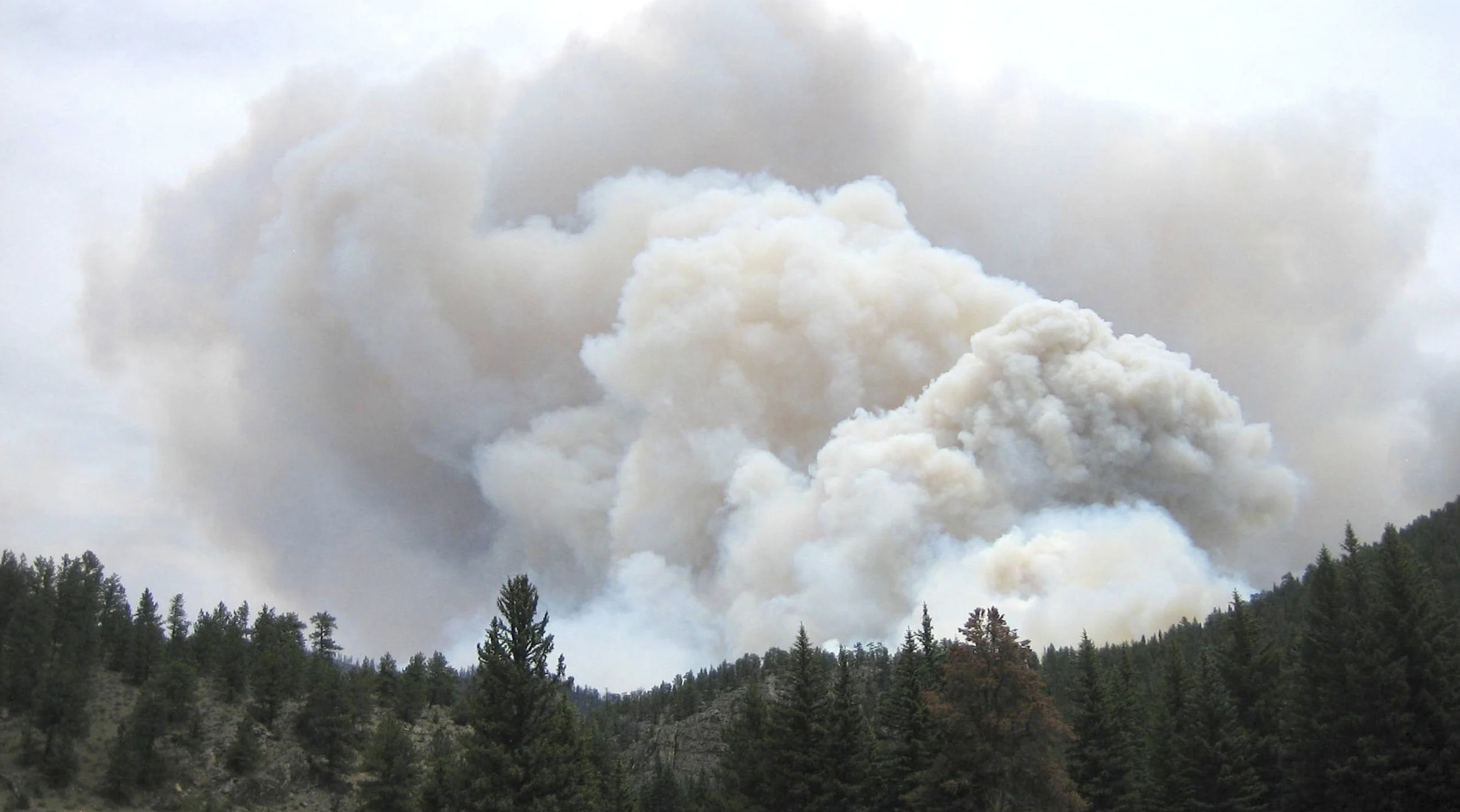
You have been checking your phone more than usual this week. Maybe it is the air quality warnings, maybe it is the footage that keeps appearing in your feeds: orange skies over Toronto, smoke so thick it turns midday into dusk, a CN Rail train surrounded by a wall of flames near Armstrong, a crew member’s voice saying: “We’re encased in flames now.”
Maybe it is the images from Collins First Nation, also known as Namaygoosisagagun, a remote Anishinaabe community about 210 kilometres north of Thunder Bay, not accessible by road, where a fast-moving wildfire tore through homes and buildings on July 14, 2026. Community members fled by boat as trees next to their houses caught fire. They left without emergency services. They carried what they could. NDP MPP Sol Mamakwa, watching from the outside, said what many were thinking: “An entire First Nation community has been erased because of this disaster.”
If you have been feeling something that you cannot name this week, something between grief and dread and a particular helplessness that comes from watching catastrophe unfold and not being able to stop it, you are not alone. And you’re emotional response is appropriate for the scale of the events we are living through.
What Is Happening Right Now in Ontario
As of mid-July 2026, more than 160 wildfires are burning across northwestern Ontario. Communities under mandatory evacuation include Collins First Nation, Whitesand First Nation, Lac La Croix First Nation, Gull Bay First Nation, Lac des Mille Lacs First Nation, and the town of Armstrong. Thousands of people have been displaced, many of them First Nations community members who fled with very little warning.
The smoke from these fires has blanketed much of Ontario. Toronto, more than a thousand kilometres to the southeast, has experienced some of the worst air quality in the world this week. Ash from the northern fires landed on vehicles in Sault Ste. Marie. Environment Canada has warned that wildfire smoke from the northwest will continue blanketing southern Ontario until at least the end of the week.
This is not a distant crisis. It is arriving in everyone’s lungs, in the orange light filtering through office windows, in children asking why the sky looks wrong. As of this writing 13 US states and 5 Canadian provinces are affected by these fires.
Sources: CBC News, July 14-16, 2026; APTN News, July 15, 2026; Global News, July 15-16, 2026
Why This Hits BIPOC and Indigenous Communities Differently
For many people, the Ontario wildfires are a frightening news story – for Indigenous and BIPOC communities, this is a specific, historical, and layered harm.
For Indigenous communities, the land is not a backdrop. The relationship between Indigenous peoples and the land is relational, reciprocal, and spiritual in ways that Western frameworks rarely capture. When the land burns, the grief is not abstract. It is the loss of sacred sites, of food systems, of the living memory held in specific places. Collins First Nation did not lose property in a disaster. They lost a community that existed in relationship with a particular piece of land, water, and forest. That is a different kind of loss than most mainstream mental health conversations acknowledge.
The history compounds this. Indigenous communities in Canada have been displaced from their lands repeatedly, through colonial policy, through residential schools, through forced relocation. For many survivors and their descendants, evacuation is not just a logistical event. It activates embodied memory of previous displacements. The body knows this pattern even when the mind is trying to manage the present moment.
For BIPOC communities more broadly, environmental racism is not a new concept. Research consistently documents that racialized and low-income communities in Canada bear a disproportionate burden of environmental harm, including proximity to industrial pollution, inadequate infrastructure during climate emergencies, and less access to the resources needed to evacuate, recover, and rebuild. The 2026 Ontario wildfires are unfolding in communities that are predominantly Indigenous and predominantly under-resourced. That is not coincidence. It is the predictable outcome of decades of policy choices about who deserves protection.
And for everyone watching from a distance, whether you are a BIPOC person in Toronto watching the orange sky, a diaspora community member watching a homeland in crisis from the other side of the world, or an Indigenous person in the south watching footage of communities being erased: the psychological weight of witnessing is documented. It accumulates. It is not weakness.
What Climate Anxiety Actually Is, and Why It Affects BIPOC Communities More
Climate anxiety is the term used to describe the psychological distress that comes from awareness of, and exposure to, the ongoing climate crisis. It includes anticipatory grief: mourning losses that are happening and will keep happening. Moral injury is part of it too, the distress of knowing harm is occurring and feeling unable to prevent it. And underneath both sits a particular exhaustion that comes from caring about something enormous in a world that keeps moving forward as if nothing is wrong.
Research published by the American Psychological Association confirms that climate anxiety is a legitimate psychological response to a genuine threat, not a disorder or an overreaction. It exists on a spectrum, from general worry to significant distress that impairs daily functioning.
For BIPOC and Indigenous communities, the burden is heavier for several reasons. First, the threat is more immediate – these are the communities most directly affected by climate events, least buffered by resources, and most likely to lose land, homes, and cultural heritage to climate disasters. Second, the psychological cost of watching your community harmed while others seem to look away carries its own weight. Third, for Indigenous peoples in particular, climate change is not a future problem. It is the latest chapter in a much longer story of having the land taken, damaged, and disrupted.
What This Can Feel Like in the Body
Climate anxiety and ecological grief do not always arrive as recognizable anxiety or sadness. They show up in other ways:
A persistent low-level dread that you cannot fully locate. Difficulty concentrating on ordinary tasks when the news is this bad. Irritability or emotional reactivity that feels disproportionate until you account for what you are actually carrying. Numbness: the protective flatness that arrives when what you are witnessing is too large to feel directly. A sense of helplessness that makes action feel pointless. Guilt about your own safety when others are not safe.
None of this is dysfunction. All of it is the body registering something accurately. The question is not whether these responses are valid. They are. The question is how to hold them without being consumed by them, and how to stay connected to yourself and your community while the crisis continues.
What Helps, and What Doesn’t
Mainstream wellness culture tends to offer individualist solutions to collective crises: breathe deeply, limit your news intake, practice gratitude, get outside. Some of this has genuine value. And for BIPOC and Indigenous people watching their communities burn, suggesting a walk outside during an air quality emergency is not adequate.
What research and Indigenous wisdom both point to is the importance of community. Collective processing – grieving together, naming what is happening together, taking whatever action is available together – is more protective than individual coping strategies for people navigating collective harm.
Cultural connection matters too. For Indigenous communities specifically, ceremony, land-based practice, and connection to elders and cultural knowledge are not supplementary supports. They are central to healing. Any mental health support that does not account for this is offering something incomplete.
Anger is also worth naming as legitimate. The Ontario wildfires are not simply a natural disaster. They are unfolding in the context of decades of provincial underfunding of wildfire management, of inadequate emergency response infrastructure in remote First Nations communities, of a political environment that continues to treat climate as a future problem rather than a present one. Grief and rage can coexist. Both belong.
Finding Mental Health Support in Ontario
If you are carrying the weight of what is happening and need support, culturally responsive care is available.
For Indigenous community members, First Nations mental health lines and Indigenous-specific crisis supports are available alongside mainstream services. The Hope for Wellness Help Line (1-855-242-3310) offers immediate mental health counselling to all Indigenous people across Canada, available in English, French, Cree, Ojibway, and Inuktitut.
For BIPOC communities across Ontario, Healing in Colour’s directory connects you with therapists who understand that your response to what is happening right now is not pathology. It is grief. It is the appropriate response to genuine loss. A therapist who already holds that understanding does not require you to defend your distress before the work can begin.
Ready to find support? Browse culturally responsive, anti-oppressive therapists in Ontario
What to look for:
- Ecological grief and climate anxiety as named areas of practice. Still emerging in the field, but some practitioners have done specific training here. It is worth asking directly.
- Anti-oppressive and trauma-informed frameworks. A therapist who understands that the climate crisis is not hitting everyone equally, and that your distress has roots in real and specific conditions, will hold your experience more accurately.
- Community and collective approaches. Healing that accounts for the collective dimension of this crisis, rather than locating everything in the individual.
You Are Allowed to Feel This
Namaygoosisagagun First Nation’s buildings were erased in a single night while the natural environment around them burned. Families fled by boat in the dark, watching their homes burn. CN Rail workers sat encased in flames near Armstrong, waiting to find out if they would make it through. Communities across northwestern Ontario are scattered in evacuation shelters in Thunder Bay, far from the land and the people they know.
For those watching, the weight of bearing witness accumulates. For those directly affected, it is immeasurable.
You do not need to minimize what you are feeling to function, you do not need to perform resilience for the comfort of others – you are allowed to grieve the land, to rage at the systems that failed these communities, to feel the particular helplessness of caring about something enormous. And you deserve support that holds all of that with you.
Find a culturally responsive therapist in Ontario
Additional Resources
Browse BIPOC therapists in Ontario
Indigenous-specific mental health support
- Hope for Wellness Help Line: 1-855-242-3310 (available in English, French, Cree, Ojibway, and Inuktitut, 24/7)
Related Reading
- When the Homeland Hurts: Mental Health Support for Diaspora Communities in Crisis
- What Is Intergenerational Trauma? And How It Shows Up in Immigrant Families
- Still Exhausted After COVID? Why BIPOC Communities Are Still Carrying It
- When Immigration Policy Becomes a Mental Health Crisis
- The Types of Unrecognized Grief We Carry in Our Bodies
Not ready for therapy yet?
- Explore our Resources page for community organizations and mental health tools
- Follow us on Instagram for culturally sensitive mental health content
- Join our newsletter for monthly BIPOC mental health resources
About Healing in Colour
Healing in Colour connects clients across Canada with BIPOC therapists and allied professionals who practice from anti-oppressive values. We believe BIPOC people, in all our intersections, deserve therapy that supports our healing and liberation.
Learn more: About Us | Our Statement of Values
If you are in crisis, please reach out to Talk Suicide Canada: 1-833-456-4566 (24/7) or call or text 9-8-8 anytime. Kids Help Phone: 1-800-668-6868 or text CONNECT to 686868. Hope for Wellness Help Line for Indigenous peoples: 1-855-242-3310.