
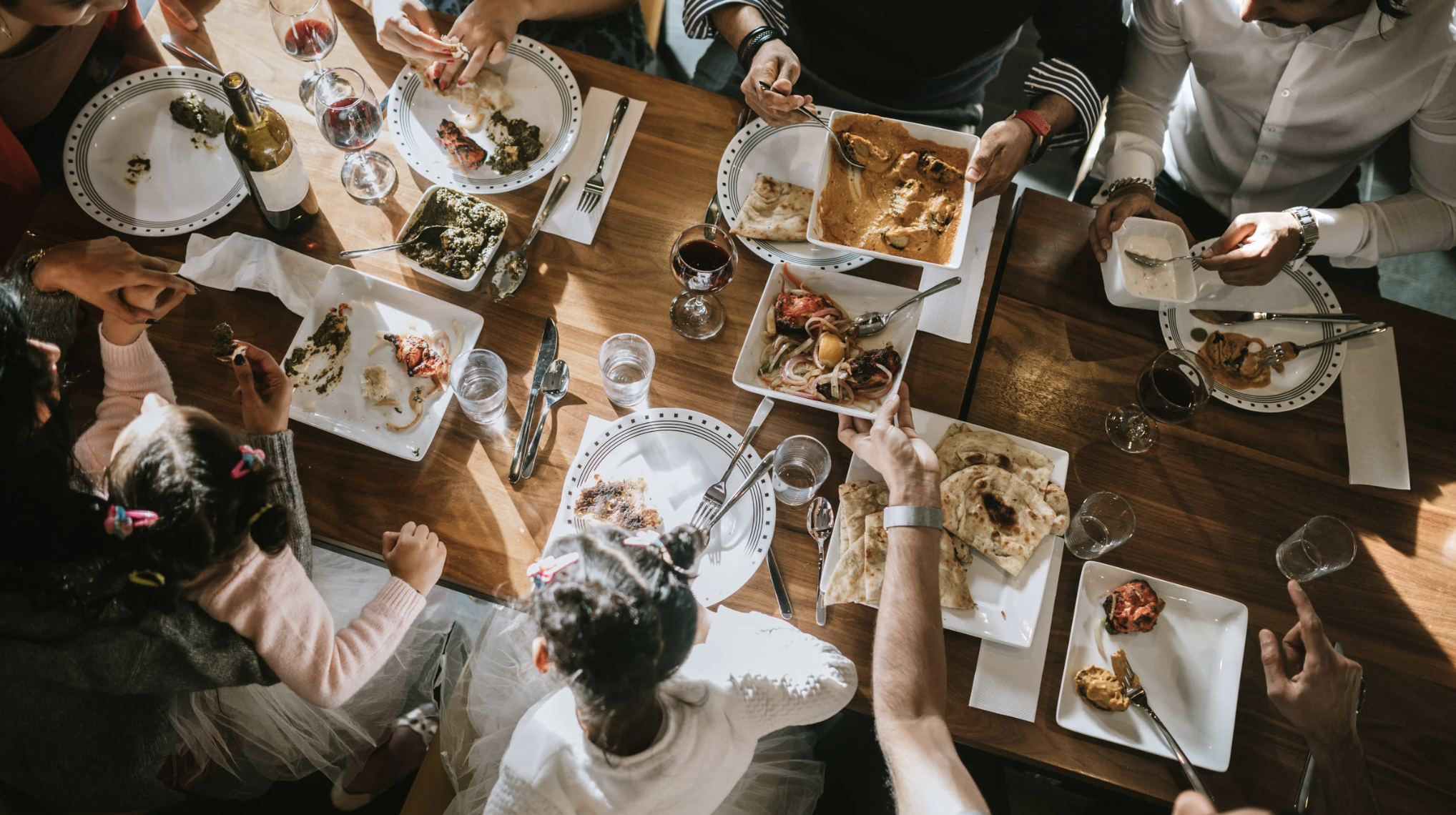
You are sitting at someone’s kitchen table. The food is good. The conversation moves easily between languages. Someone laughs at something that only makes sense if you grew up in a particular place, with a particular history, and everyone at the table laughs too because they already know – this is what community safety and belonging feels like. Not the performed version. The version where you do not have to explain yourself before you can relax.
For many BIPOC people living in Western cities, this feeling is familiar from childhood, from home culture, from family gatherings, and increasingly difficult to find in the rest of daily life. The isolation of North American urban culture has a way of making that kitchen table feel like an exception rather than a foundation. And in a moment when institutions feel less trustworthy, when political uncertainty creates a low hum of anxiety that does not fully resolve, the absence of genuine community becomes more acute.
This blog is about what many BIPOC communities have always known about building safety – and how to find your way back to it.
What Home Cultures Know That Western Cities Forgot
Many BIPOC communities carry deep, practised knowledge about collective safety that has nothing to do with surveillance, policing, or formal systems of control. This knowledge was not incidental. It developed because formal systems could not be trusted to provide safety for racialized communities, and so communities built their own.
In many Indigenous communities across Turtle Island, safety has always been relational. The land holds knowledge. Elders hold wisdom. The community holds accountability. When harm occurs, the response centers on restoring relationship and balance, not isolating the individual for punishment. This is not a romanticized past. It is a living practice that many Indigenous communities maintain and actively rebuild after the systematic disruption of colonialism and residential schools.
In many West African, Caribbean, and diasporic Black traditions, the concept of mutual aid – neighbors looking after neighbors, pooling resources in crisis, holding one another through difficulty – predates any formal social safety net. Rotating savings clubs, community care networks, faith communities that function as extended family: these are technologies of collective safety that BIPOC communities developed precisely because formal institutions could not be counted on.
In many South Asian, East Asian, and Latin American communities, the extended family itself functions as a safety infrastructure. The multigenerational household is not a failure to individuate. It is a sophisticated system of mutual care, intergenerational knowledge transfer, and collective risk management that Western individualism systematically misreads as dependency.
These models are not cultural curiosities. They are proven, living approaches to safety that function without surveillance, without punishment, and without requiring people to be legible to systems that have historically used that legibility as a tool of harm.
The Loneliness That Western Cities Produce
Understanding why rebuilding this kind of safety feels hard requires naming the specific context BIPOC people are navigating in Canada.
A 2025 study published in the Journal of Community Psychology, using three large-scale Canadian datasets of over 20,000 participants, found that lower loneliness was consistently predicted by higher feelings of connection in one’s community. Urban participants reported higher rates of loneliness than rural participants, with researchers noting that people in rural areas benefit from family networks, rootedness, and what they describe as “automatic belonging” rather than having to work to develop social connection.
That phrase deserves attention: automatic belonging. The sense that your place in a community is given rather than earned, that you do not have to perform or prove yourself to be held by the people around you. Many home cultures build this into their structure. Western urban culture, with its emphasis on individualism, privacy, and self-sufficiency, systematically dismantles it.
For BIPOC people who came from, or whose families came from, cultures with tight social networks and collective responsibility for one another’s safety, the isolation of Western urban life is a specific kind of loss. It is not just loneliness. It is the loss of a whole architecture of belonging that once held you.
In a moment when political uncertainty, surveillance anxiety, and institutional distrust are all rising simultaneously, that loss becomes more costly. The communities most targeted by systems that do not keep their promises need the thing those systems most effectively destroy: genuine, sustained connection with one another.
Source: Baerg MacDonald and Schermer, Journal of Community Psychology, September 2025. doi: 10.1002/jcop.70042
Three Models of Community Safety Worth Knowing
BIPOC communities and scholars have developed frameworks for building safety collectively that are worth naming explicitly, because they represent genuine alternatives to the surveillance and punishment models that dominate mainstream thinking about community safety.
- Transformative justice asks: how do we address harm without reproducing the systems that cause harm? Rather than routing conflict through systems that many BIPOC communities have experienced as sources of additional harm, transformative justice works through community processes to address conflict head on: supporting those harmed, building genuine accountability in the person who caused harm, and repairing relationship where possible. The framework draws heavily on Indigenous restorative justice traditions that existed long before formal legal systems arrived on this land. Organizations across Canada practice transformative justice approaches in community mediation, housing, schools, and workplaces.
- Mutual aid is the practice of communities meeting one another’s needs intentionally, outside formal charity or government systems. It operates on the principle that communities already have what they need among them if they organize it well. During the pandemic, mutual aid networks across Canada moved food, medication, childcare, and support to people who needed it faster and with more dignity than formal systems could. Many BIPOC mutual aid networks are now expanding their scope to include legal support, emergency housing, and mental health resources in response to the current political moment.
- Community accountability is the practice of creating shared agreements within a community about how harm will be addressed, and building the relationships and skills to follow through on those agreements without relying on external enforcement. This approach requires trust, communication, and willingness to be in difficult conversations. The process is slow. Lasting change is also far more likely here than through the threat of punishment alone.
All three of these models share a common requirement: genuine, sustained relationship. They cannot function in isolation. They are what becomes possible when belonging is treated as a practice rather than an accident.
One Practical Way to Begin
If the isolation of Western urban life has left you without the kind of community that makes these practices possible, the question is how to begin building it.
One concrete starting point: identify one person in your life with whom you feel genuinely safe and make a specific commitment to regular connection. Not a vague intention to spend more time together but a standing arrangement. Monthly dinner. Weekly walk. A standing call. Something with enough structure that it continues even when life gets busy.
That single relationship, tended consistently, is the beginning of a network. One becomes two becomes five becomes a community with enough trust to actually look after one another.
This is not a small thing. In a cultural context that systematically produces isolation, choosing consistent and intentional connection is itself an act of resistance. It is also the foundation on which every other model of community safety is built.
How Therapy Supports This
Therapy, done well with a culturally responsive practitioner, does not just address individual symptoms. It builds the internal capacity to be in genuine community.
For many BIPOC people, the cumulative experience of isolation, hypervigilance, and institutional distrust has made genuine connection feel risky. Betrayal has come from the places that promised safety. Vulnerability has cost something. Over time, the nervous system learns that being fully seen is dangerous.
A therapist who understands this history can help you develop the internal resources to take the risks that belonging requires: to identify safe people to be in relationship with, show up consistently in relationships, to repair when things go wrong rather than withdrawing, to tolerate the discomfort of being truly known by another person.
Therapists who practice from a social justice framework understand that your isolation is not a personal failing. It is the predictable consequence of systems designed to keep racialized communities atomized and harder to organize. Healing, from this framework, is not only personal. Building genuine community is part of it.
In Montreal, finding a therapist who already holds the specific texture of BIPOC experience in this city matters. The particular communities that call this place home, the ways that belonging and exclusion operate here, the languages and histories that shape daily life: a therapist who understands this context does not require you to explain yourself before the support can begin.
Ready to find a therapist in Montreal who holds this full context? Browse culturally responsive, anti-oppressive BIPOC therapists in Montreal
The Safety Your Ancestors Built Is Still Available to You
The belonging your ancestors built in conditions far more hostile than these was not luck. It was practice, repeated across generations, in kitchens and community halls and gathering places and land. It was the daily choice to show up for one another even when, especially when, formal systems offered nothing.
That practice is not lost. It is waiting to be rebuilt, one consistent relationship at a time, one shared meal at a time, one moment of genuine presence at a time.
Therapy is one place where that rebuilding becomes possible. Not because a therapist replaces community, but because a good therapist helps you become someone who can build it. Someone who has done enough of their own work to show up for others. Someone with enough internal ground to be genuinely present rather than performing connection while waiting for something to go wrong.
The kitchen table is still there. We are here to help you find your way back to it.
Find a therapist in Montreal who already understands
Additional Resources
Browse BIPOC therapists in Montreal
Related Reading
- What Is Intergenerational Trauma? And How It Shows Up in Immigrant Families
- When Collective Chaos Translates to Chaos in Our Minds
- When Immigration Policy Becomes a Mental Health Crisis
- Therapy as Solidarity: Building Capacity to Hold the Polycrisis Together
Not ready for therapy yet?
- Explore our Resources page for community organizations and mental health tools
- Follow us on Instagram for culturally sensitive mental health content
- Join our newsletter for monthly BIPOC mental health resources
About Healing in Colour
Healing in Colour connects BIPOC clients across Canada with therapists and allied professionals who practice from anti-oppressive values. We believe BIPOC people, in all our intersections, deserve therapy that supports our healing and liberation.
Learn more: About Us | Our Statement of Values
If you are in crisis, please reach out to Talk Suicide Canada: 1-833-456-4566 (24/7) or call or text 9-8-8 anytime. Hope for Wellness Help Line for Indigenous peoples: 1-855-242-3310.